Furniture is a geometry problem before it is a lifting problem
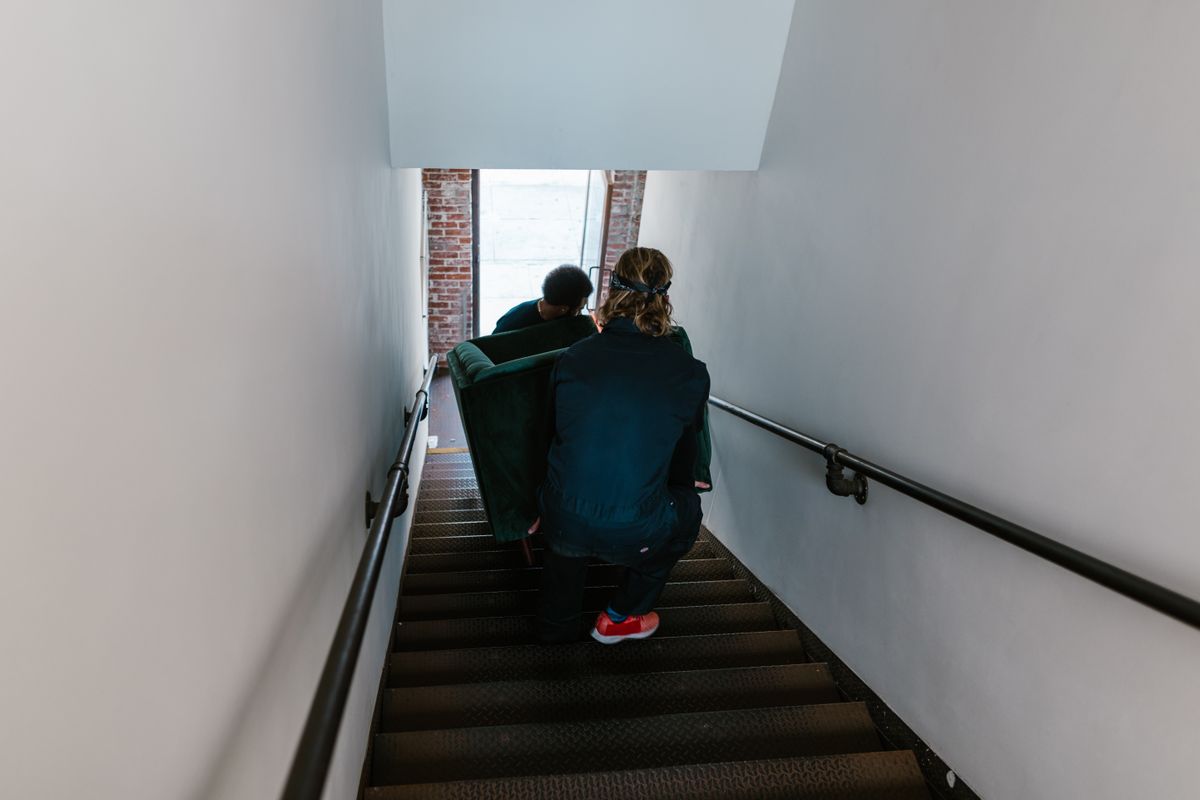
People assume furniture removal comes down to strength. It rarely does. Two reasonably fit people can pick up almost any sofa ever made; what stops them is the doorway, the stair landing, and the ninety-degree turn between the two. A piece that walked into a room eight years ago does not always walk back out, because it was carried in before a banister went up, or through a slider that has since had a deck built against it, or by a delivery crew who took the legs off and never mentioned it.
So the first thing we do with a large piece is measure the exit rather than the item. The narrowest point on the path is what governs, and it is almost never the front door - it is the turn at the bottom of a staircase, the gap between a newel post and the wall, or a hallway that a washer and dryer already narrowed. If the diagonal of the piece will not clear the narrowest point, no amount of lifting changes the answer, and the job becomes a disassembly job instead.
That distinction matters to you because it is the difference between fifteen minutes and an hour. Sectionals usually come apart at the connectors and are the easy case. Recliners come apart at the back brackets. Solid dining tables lose their legs. Bed frames are designed to disassemble. Where a piece genuinely cannot be reduced - a one-piece sofa with a welded frame, an armoire built in place - we will say so plainly and talk through the options rather than force it and gouge a wall on the way.
The sleeper sofa is the hardest common item in a Springfield home
If there is one piece that reliably surprises people, it is the hide-a-bed. A sleeper sofa carries a folded steel bed frame, a mattress, and a spring mechanism inside a frame that already weighs what a normal sofa weighs. It is heavier than an equivalent recliner sectional and heavier than most refrigerators, and unlike a fridge it has no flat side, no handholds, and no place to hook a strap.
It also cannot be tipped on its end and walked around a corner the way an ordinary sofa can. Stand a sleeper up and the internal frame shifts, which either jams the mechanism or drives it into the upholstery from the inside. On a turning staircase that is the moment somebody gets hurt, so we plan sleepers as a two-person carry on a fixed route, or we open the mechanism and remove the bed frame first and take the piece out in two trips.
None of this is a reason to dread the call. It is a reason to mention the word "sleeper" when you first describe the piece, because it changes the crew size and the time we block out. The same goes for anything with a motor in it, and for the oversized power-reclining sectionals that have become common - those are several separate heavy pieces pretending to be one item, and they are much easier than they look once the connectors are found.
Mattresses have their own rules, and the curb is not one of them
Mattresses are the single most common reason people discover that ordinary trash service will not solve their problem. They are bulky, they are awkward to compress, and they are made of layered materials - foam, fiber, adhesive, and steel - bonded together in a way that makes them genuinely difficult to recycle rather than merely inconvenient. That is why so many end up leaning against a garage wall for a year.
Two practical points are worth knowing before you decide what to do with one. First, charities do not take used mattresses, and this is not a matter of condition or persuasion - it is a health and liability rule that essentially every donation operation applies, so a nearly-new mattress in a guest room gets the same answer as a fifteen-year-old one. Second, if there is any history of bed bugs, tell us before we arrive rather than after. It changes nothing about whether we take it, but it changes how the piece is wrapped and routed, and handling it correctly protects the truck and the next house we visit that day.
Box springs come with a small bonus: the frame inside is timber and steel, so the wood and metal separate cleanly at the disposal end where a foam mattress mostly cannot. It is a modest win rather than a dramatic one, but it is real, and it is the sort of thing we would rather explain honestly than dress up.
What can genuinely be donated, and what gets turned away
A large share of the furniture we carry out of Springfield homes is perfectly good, and where a piece is usable it should go to somebody who needs it rather than into a hole in the ground. Habitat for Humanity ReStore and the area thrift operations take real volume of exactly this kind of thing, and routing a dresser back into circulation is better on every measure than disposing of it.
What gets declined is more specific than most people expect, and knowing the rules in advance saves a wasted afternoon. Upholstered pieces with structural damage, tears, heavy staining, smoke odor, or pet damage will not be accepted, because a charity has to be able to resell them. Particle-board furniture that has already been assembled and moved once is usually turned away too - not out of snobbery, but because the fasteners strip and the panels swell, so it will not survive another disassembly. Anything missing its hardware, its glass, or a structural rail is a decline. Solid wood, metal, and intact upholstered pieces in clean condition are the reliable yes.
A meaningful number of our calls come from people who already tried. A donation pickup was scheduled, the crew looked at the sofa, and it was refused at the door - which leaves you with a piece you had mentally written off and no plan for it. That is a normal reason to call, not a failure on your part. We will tell you honestly on the walkthrough which pieces we think will be accepted and route those separately, rather than promising a donation outcome we cannot control.
Delivery day is when most people call
The most predictable furniture removal job in Springfield is the one that shows up alongside a new piece. Retail delivery crews increasingly will not take the old item, or will only take it if it is the direct replacement, is already fully disassembled, and is standing in the entryway when they arrive. Even where a haul-away is offered at purchase, it usually excludes mattresses, anything with a mechanism, and anything not being swapped one-for-one.
The result is a familiar sequence: the new sectional arrives, the old one goes into the garage "for now", and six months later the garage is the problem instead. If you know the delivery date, it is worth having the old piece gone before or on the same day - the room only has to be cleared once, and you never live with a sofa in a parking bay.
If the garage has already absorbed a few of these, the piece-by-piece approach stops making sense and our Springfield garage cleanout service is the cheaper way to handle it, because you are charged for one combined load rather than for four separate visits to collect one piece each. The same logic applies in reverse: if furniture is only part of what is going, a single general junk removal visit covers the whole lot in one price. Our Springfield cost guide lays out how volume pricing actually works.
Move-out season changes what furniture removal looks like here
Springfield's rental market is shaped by the university, and late spring concentrates an enormous amount of furniture into a very short window. The stock coming out of student housing has a particular character: it is largely secondhand, it was chosen to be disposable, and it is not worth the cost of transporting home to another state. Futons, particle-board desks and shelving, papasan chairs, mini-fridges, and mattresses that were bought used and will not be kept make up most of it.
Two things about those jobs differ from a normal household call. The building governs the schedule more than the contents do - whether there is a service elevator, how long a vehicle may occupy the loading area, and who else is moving out of the same stairwell that afternoon will shape the booking far more than the number of pieces will, and our guide to clearing an apartment in Springfield covers what to check before booking. And the deadline is usually immovable - a lease end date is not a preference, so these are worth arranging early rather than in the last forty-eight hours when every crew in town is committed.
Landlords and property managers turning a unit between tenants are the other half of that season. There the goal is a unit that is genuinely empty and ready to show, which means the closet shelf and the balcony get cleared too, not just the visible furniture. Estate and downsizing work runs on a different calendar and a different pace, and we cover the pricing for that scale separately in our estate cleanout guide.
Pianos, safes, and the pieces that need a specialist
There is a category above furniture where honesty is more useful than salesmanship. Upright pianos, gun safes, slate pool tables, and large aquarium stands are not simply heavy - their weight sits in one concentrated place, which is what threatens a stair tread, a doorframe, or a floor rather than the crew's backs.
We do remove these, and the approach is different: more people, proper equipment, a route planned in advance, and in some cases dismantling on site. A slate pool table comes apart into slate sections and a frame, and moving one whole is the wrong instinct. A gun safe on an upper floor needs a plan before anybody touches it. A grand piano is a specialist job, and if that is what you have, we will tell you so rather than take on something that ought to go to a piano mover.
The general rule holds across all of them: describe the piece accurately when you call, including where in the house it is and what the path out looks like. An accurate description is what lets us arrive sized correctly for the job, and it is the difference between the piece being gone that day and a second visit.
What is useful to tell us before the truck is scheduled
You do not need to prepare anything or move a piece toward the door - the carry is the service. A few details, though, genuinely change how we plan the job: which floor the piece is on, whether the stairs turn, whether there is an elevator, and whether anything is a sleeper, a recliner, or motorized. Photographs of the piece and of the path out are worth more than a careful description, and a short video walking from the item to the front door tells us almost everything.
Also say if there are items you specifically want donated, and set aside anything that is staying. The most common regret in this line of work is a piece loaded that should not have been, and a truck is far easier to load than to unload.
Appliances travel on a separate track from furniture, because a sealed refrigerant system must be drained down by a licensed technician before the shell can be scrapped. If a fridge or a washer is leaving in the same visit, our Springfield appliance removal page explains how those are handled. When the room is ready to lose the piece, send our Springfield crew the details and we will come out and put a firm number on it at no charge.